


Author
[AUTHOR: Guest Contributor, PaperTradingApp.com] [DATE: Published September 12, 2026, Last Updated September 12, 2026]
The problem with most new traders is they have no idea that in their first year they shouldn't be trading, because they simply don't have the experience. The reason most new traders lose their money is because they do not have the experience of trading, and they do not do that because they are stupid, but because they haven't practiced. It's easy to make mistakes when plunging into the real markets with real capital, including mistakes regarding risk, discipline, and emotional control. There's a more intelligent way to get going.
Testing out ideas in virtual capital allows you to gain confidence in your approach, develop a better one, and learn how you react in the market without real money loss. This guide explains in detail how to use simulated trading tools to build a trading strategy that you can use in the real market.
Virtual capital is the money that is used in the virtual environment that imitates the real market. It allows you to trade, monitor your performance and even feel the movement of the market without taking any risk of losing money.
When you open a practice account, you're given a set amount of virtual funds — often ₹8,00,000 to ₹80,00,000 — to trade with. Prices, charts, and order execution typically reflect live market data, so the experience feels authentic even though the money isn't real. You can buy, sell, short, and manage positions exactly as you would in a live account.
One of the myths is that virtual trading is “too easy” since it isn't a real trade. In truth, it's not the money which is valuable, it's the decision-making process. Traders who take it seriously cultivate the same analytical skills that they need during live trading: chart reading, risk management, and trading plans.
Beyond basic order placement, practicing with simulated capital trains three critical operational muscles:
There are many different types of simulators. A good paper trading app should closely mirror the actual trading environment to ensure you are able to apply what you learn to your real trading.
Platforms should also have real-time or near-real-time market data, support various order types (market, limit, stop-loss), allow users to track their portfolios, and provide access to different asset classes (stocks, options, futures). The more lifelike the surroundings, the more helpful your practice will be.
Fans of the software can try many brokers' free paper trading app, which is a great place to begin. When you're past the basics and need to tweak a particular method, you may find that paid or premium versions offer more advanced charting, more historical data and more powerful backtesting tools.
To ensure your virtual practice translates seamlessly to live trading on exchanges like the NSE and BSE, ensure your chosen platform supports:
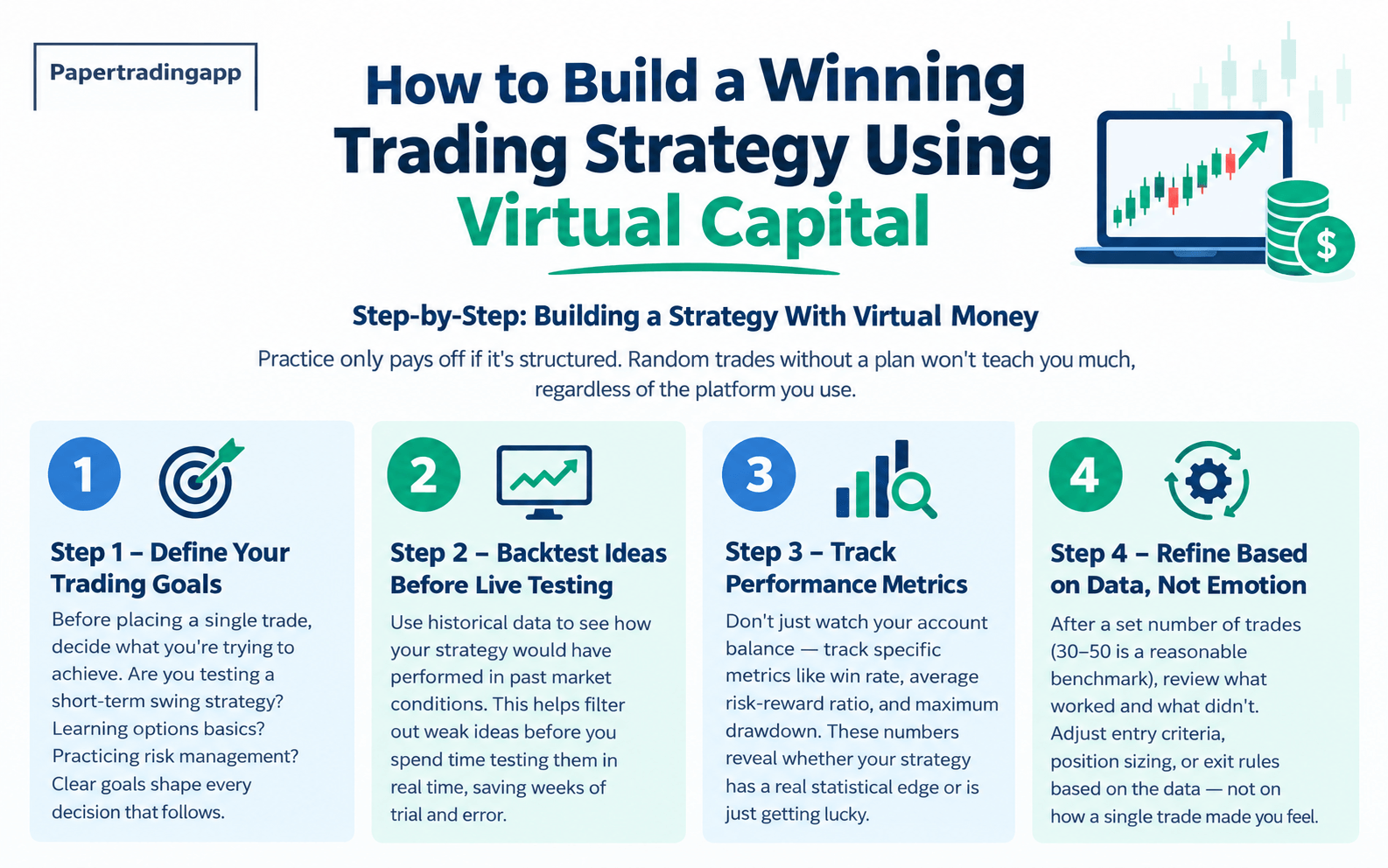
The only way to get good at something is to do it in a systematic way. Any random trading without a strategy won't be of any help, no matter which platform you are using.
Determine the goal of your trading before making any trades. Are you using a short or medium term swing strategy? Learning options basics? Practicing risk management? If you have goals, your actions will be guided accordingly.
See how your strategy fared in the past, using historical data. This is a way to eliminate some of the weaker concepts before you put time into testing them, saving weeks of wasted time and effort.
Keep not only a look on your account balance, but also on key metrics such as win rate, average risk-reward ratio, and max drawdown. These numbers can show you if you're playing a strategy that has any real statistical advantage or just getting lucky.
1. Win Rate (%):
2. Risk-to-Reward Ratio (RRR):
3. Profit Factor:
Total Gross Profits ÷ Total Gross Losses. A ratio above 1.75 indicates robust strategy durability across different market phases.4. Maximum Drawdown (MDD):
5. Mathematical Expectancy:
Expectancy = (Win Rate % × Average Win Amount) - (Loss Rate % × Average Loss Amount)
Once you have completed a certain number of trades (30–50 is a good benchmark), look back on your trades to see what was successful and what was not. Don't change the criteria at the entry, position size or exit point based on how one trade made you feel, but based on the data.
Bad habits can creep in and continue to follow you right into live trading, even if you aren't in a risky situation.
With no real monetary risk, it is easy to make trades spontaneously or follow all market movements. This puts us in a habit that will work against us when we're playing for the big bucks. Play the same way you would in real markets on your simulated account.
With just a practice account, many new traders make unrealistic bets on each trade, since it doesn't matter if they lose. This goes against the principle. Use the same position sizing and risk per trade strategy (usually 1–2% of your capital) as you would with real money.
Position Size (Quantity) = (Total Capital × Risk Percentage) ÷ (Entry Price - Stop Loss Price)
Step-by-Step Indian Market Example:
Regardless of how confident you feel, never exceed the calculated position size. Practicing this formula in simulation builds the instinctual risk management required to protect real capital.
There should be a conclusion in practice. Those who don't move out of simulation mode may end up feeling secure enough and with a false sense of security because trading in simulation does not give you the real sense of a loss.
When your strategy has a good number of trades, has been profitable on a regular basis, and you know and understand the reason your strategy is profitable, you are probably ready to go live.
Don't go from 100% virtual capital to 100% real capital all at once, go slow. Use a small account to trade and if you use the same rules you used in a simulation account, gradually increase your size as your results and confidence continue to improve in the real market.
Building a winning trading strategy isn't about finding a shortcut — it's about developing consistent, tested habits before real money is at stake. A paper trading app gives you the space to experiment, fail safely, and refine your edge without financial consequences.
Ready to test your strategy risk-free? Start practicing with a paper trading app today and build the confidence to trade smarter with real capital.
The majority will supply a free service, albeit with restricted capabilities, and advanced features might need a subscription. Platforms like Arthwise provide full access to real-time NSE/BSE feeds, ₹10,00,000 in virtual funds, and advanced derivatives tools completely free of charge.
Most advisors advise that you practice trading at least for one to three months prior to trading real money, while making a profit. Ensure you have documented at least 50 to 100 simulated trades showing a positive risk-reward ratio and steady equity curve before funding a live brokerage account.
Nearly as it is done in real trading, lacking liquidity constraints and emotions. A high-fidelity paper trading app connects directly to real-time exchange feeds, replicating live order books, price volatility, and option pricing behavior accurately.
Indeed, there are numerous applications that allow simulated trading in stocks and options, futures and Forex. Modern platforms offer complete F&O option chains with live Implied Volatility (IV), Open Interest (OI) tracking, and multi-strike option strategy builders.
Not taking risk-taking seriously enough, resulting in unrealistic risk-taking habits. Overtrading, betting oversized quantities, and ignoring stop-loss rules because "it isn't real money" are the most damaging mistakes. Treat virtual capital with the same respect as your hard-earned savings.